
Nevada People Directory Routes
Nevada people directories answer different questions because each keeper records a different relationship. A city contact list identifies an office. A university directory connects a person to a campus unit. County recorder indexes list parties named on filed instruments, while assessor rolls name assessed property owners. Licensing boards confirm a credential, and business filings identify entities, agents, and filed officers. Libraries and archives reach back through city directories, yearbooks, telephone books, census material, and organizational rosters.
| Directory | Who It Lists | Keeper | Access |
|---|---|---|---|
| Agency and local-government contacts | Officials, offices, departments, some named staff | Each Nevada agency, county, or city | Web pages, rosters, minutes, or main line |
| UNR and UNLV directories | Faculty, staff, departments, and public campus contacts | Each university | Free public directory; some communities require sign-in |
| K-12 school directories | Schools, administrators, and staff where published | Each of Nevada’s 17 school districts | District or school site; no statewide staff search |
| Recorder party index | Grantors, grantees, lien parties, and other recorded roles | Each county recorder | County portal, counter terminal, or copy request |
| Property owner roll | Current assessed owners and parcel details | Each county assessor | Owner, address, or parcel search; counter fallback |
| Credential and entity lookups | Licensees, entities, agents, and filed officers | Nevada boards and Secretary of State | Board-specific lookup or eSOS |
| Historical city and phone directories | Past residents, businesses, occupations, and address occupants | Libraries, UNR, UNLV, and archives | Catalog, reading room, microfilm, or digitized volume |
| Cemetery and community registers | Burials, plot records, members, and organization participants | Cemetery, church, local government, or manuscript repository | Database, register, finding aid, or keeper inquiry |
Start with the directory tied to the person’s known role. For a current public office, search the agency, board, city, or county site. For a campus affiliation, use the institution directory. An owner name belongs in the assessor roll, while a deed party belongs in the recorder index. A past resident calls for a city directory, yearbook, newspaper, or census. Nevada has 16 counties plus independent Carson City, so county-based directories require the right jurisdiction.
Nevada Government Directory Gaps
Nevada government contacts are agency by agency. Elected-official rosters, boards and commissions, agency pages, and meeting minutes can be more useful than a claimed statewide employee phone book. The research did not locate a stable statewide employee-name directory, so an office list should not be presented as one. City and county sites also vary. Some name staff, while others publish only a division and main telephone number.
The official Reno department directory is a clear example of the second type.
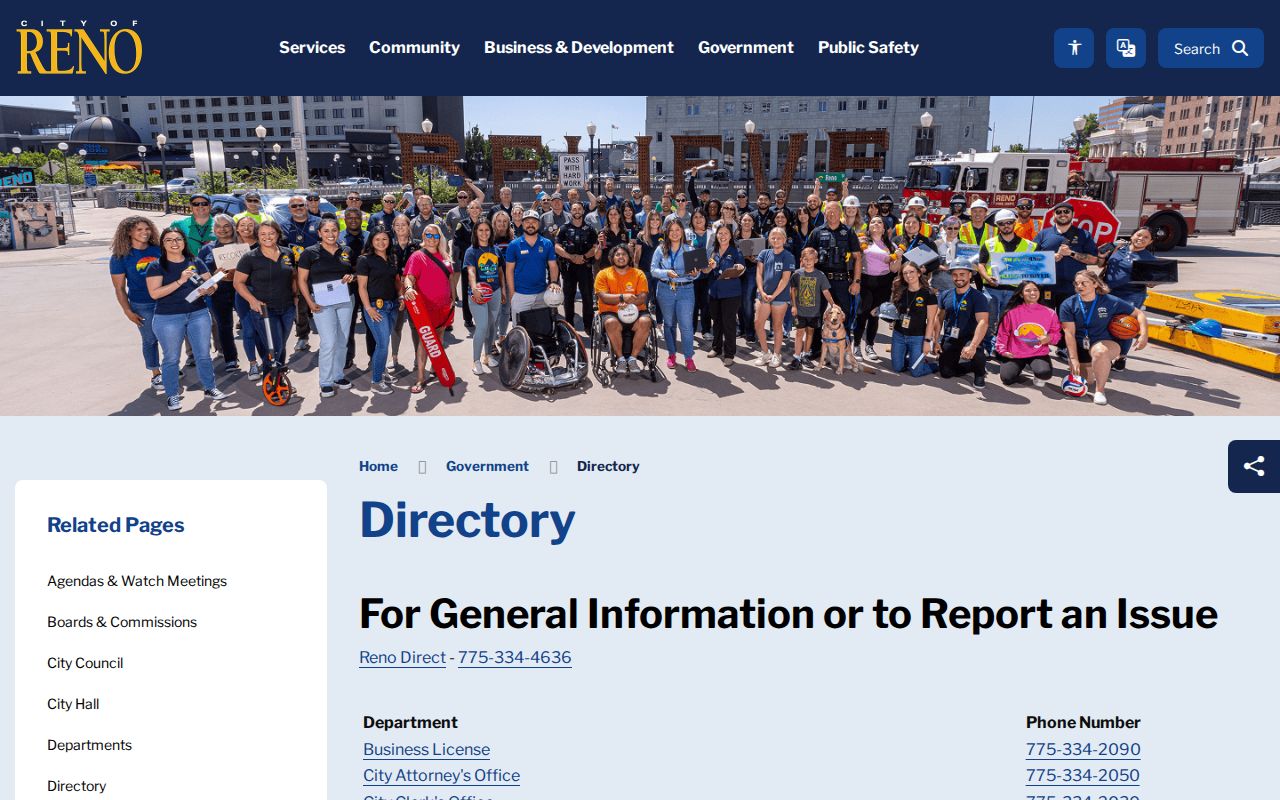
The directory browses departments such as the City Clerk, Finance, Fire, Police, Public Works, and Code Enforcement. Its department links may lead to named contacts, but its global “How can we help?” box is a general site search rather than a dedicated staff lookup.
When a name is absent, open the department page and call its main line. Check a board or commission roster if the person serves in an appointed role. Reno also publishes current committee membership through its boards-and-commissions system. For an existing government record that is not posted, the relevant clerk or records officer is the fallback. The Nevada Public Records Act process belongs with the Nevada public records access details, not with a directory entry.
Nevada University Directory Fields
The University of Nevada, Reno and the University of Nevada, Las Vegas each maintain public institutional directories. They list campus roles and contact points, not private addresses. Nevada’s higher-education directory landscape remains institution-specific, and community colleges have their own sites. Student and alumni directories often require authentication, so public faculty and staff tools should not be mistaken for open student lists. The UNR directory was documented with the following controls, but its endpoint did not resolve reliably during final research. Verify the live form before relying on its exact layout.
| Field or Control | Type | Required | How It Works |
|---|---|---|---|
| Search | Text | Yes | Search for a person or department; try surname and name variants. |
| People/Department result mode | Result grouping | No | Separates institutional people from campus units. |
| Search icon | Button | Not applicable | Runs the directory query. |
A typical public university entry is a sample staff record, not a private-address listing. Its useful fields may include:
- Full display name and institutional title
- Department, school, program, or campus unit
- Campus address, mail stop, or office location
- Public work telephone and institutional email
- A linked faculty or staff profile
- Biography, expertise, courses, or office hours on a department page
Those fields establish an institutional connection. They do not establish where a person lives.
Note: If a campus name search fails, try the department directory and the person’s surname before treating the affiliation as unconfirmed.
Nevada Owner and Party Directories
County public records can work as specialized Nevada people directories. An assessor roll lists the assessed owner of a parcel, along with the situs address, tax-mailing address, parcel number, valuation, land and building facts, and sometimes sales history. “Situs” means the physical parcel location. The tax-mailing address is where notices go. If those addresses differ, the difference is a dated research lead, not proof of current residence.
A recorder index answers another question. It lists grantors, grantees, lien parties, and other roles on recorded instruments. “Grantor” is the transferring party and “grantee” is the receiving party. Clark County’s recorder portal searches last name, optional first name, name match mode, and recording dates. Its online official-record index begins in 1988, with older holdings available through microfilm and the public research area. Washoe’s portal requires a party name and an approximate transaction date, cannot search by address or parcel number, and offers free unofficial watermarked images.
Use the right fallback: search an address in the assessor, then carry the owner name into the recorder. If the web index is too recent, use the counter, telephone, mail, archives, or library directory run documented for that county.
Property directories describe ownership interests, not occupants. Trusts, entities, mailing agents, parcel splits, and later deeds can change the trail. County treasurer records and GIS maps add tax status and location context, while old reverse directories can identify a listed occupant at a street address.
Nevada Business and License Directories
Nevada professional directories are kept by the board that issues each credential. The State Bar of Nevada may show an attorney’s status, bar number, public contact, and discipline links where published. Medical, nursing, contractor, real-estate, cosmetology, gaming, and educator records each follow their own keeper and interface. Search the precise board. No single umbrella license result should be treated as complete.
The Secretary of State’s Nevada Business Search accepts an entity name or entity number and may offer officer-name and registered-agent-name criteria. A result can show the legal entity name, state identifier, entity type, status, registration dates, registered agent, filing history, and managers or officers when a filed form calls for those roles. A registered agent is a service contact, not necessarily the owner. Document orders may have a separate cost.
County-filed fictitious firm names and local business licenses require another layer. Search the county clerk for the place of business, then the city or county licensing office. Chambers may publish business members, while public board minutes can identify participants. These sources connect a person to a filed or public role. They do not prove a private residential link.
Note: A license, agent, or officer entry confirms a filed role and date; it does not establish every current business relationship.
Nevada Library Directory Collections
Libraries preserve directory evidence that current portals cannot supply. Current carrier white pages are incomplete, while Nevada public-library local-history rooms may hold telephone books, Polk city directories, reverse or criss-cross directories, yearbooks, obituary files, maps, newspaper microfilm, and licensed genealogy databases. Some databases require an in-library session or a card. Catalog descriptions often summarize a whole run without listing every year, so ask staff to confirm the exact volume before planning a visit.
| Collection | Directory Value | Access Note |
|---|---|---|
| UNR Special Collections and University Archives | Nevada and Great Basin manuscripts, campus archives, mining, ranching, Basque, and northern community records | Catalog, reference help, and repository access |
| UNLV Special Collections and Archives | Las Vegas, gaming, entertainment, architecture, oral history, photographs, and southern communities | Collection descriptions and repository access |
| Nevada State Archives | Territorial and state records, selected local series, census material, military rolls, and land patents | Search by office or record group as well as surname |
| Public library local-history rooms | City and telephone directories, newspapers, yearbooks, clipping files, and genealogy tools | Exact years and remote-service limits vary |
Treat a library catalog as the first access channel, then ask about a reading-room visit, microfilm, licensed database access, or a short reference check. Exact-year gaps should remain gaps until staff confirm the volume.
UNR Directory Collection Trails
The UNR Special Collections overview introduces northern Nevada and Great Basin research holdings.
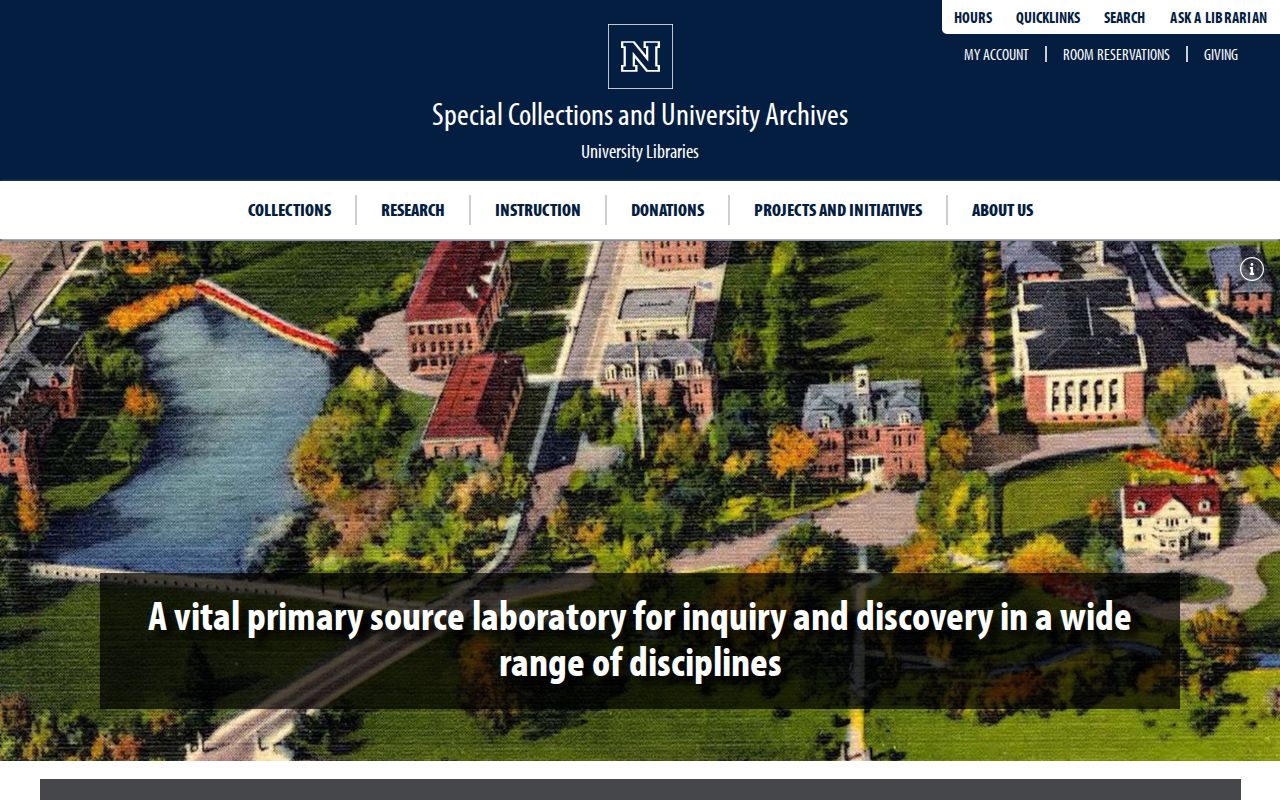
That Nevada repository is especially useful when a person appears through a mine, ranch, Basque group, campus unit, or northern Nevada organization instead of a standard civil index. Its manuscripts, maps, photographs, campus archives, and organizational collections can supply context that a current directory omits.
UNLV Directory Collection Trails
The UNLV Special Collections and Archives serves a distinct Nevada directory and community trail.
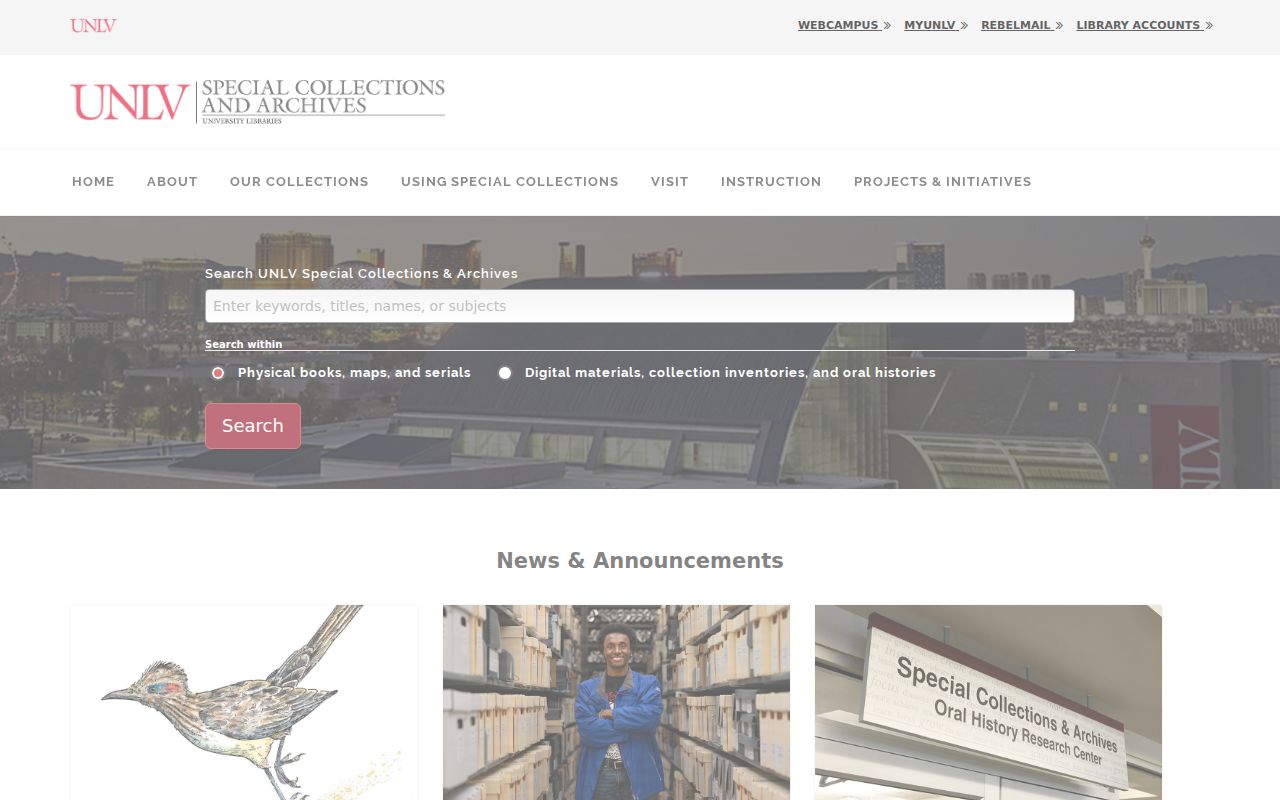
Its manuscripts, photographs, and community collections can connect southern Nevada residents to gaming, entertainment, architecture, public life, and fast-growing Las Vegas communities. Search both a person and the casino, group, project, or neighborhood tied to that person.
Nevada Community Roster Directories
Some Nevada people never appear in a formal staff or owner directory, yet they are named in a group record. Railroad and mining-company files, union lists, lodge minutes, veterans’ rosters, fraternal records, congregation archives, university yearbooks, and student newspapers can place a person in a town or organization at a known time. Search the organization and locality before the surname because manuscript collections are often arranged by creator.
UNLV oral-history projects add voices to those lists. The Ralph Roske project contains nearly 1,200 interviews begun through student work in the 1970s. The Nevada Test Site Oral History Project includes more than 150 interviews conducted from 2003 through 2008, and the School Principalship project spans 1986 through 2010 with roughly 400 interviews. These are not simple phone-book entries. They can link a name to work, family, migration, community events, and other people.
Cemetery registers, funeral-home archives, and obituaries form another directory chain. Start with the cemetery or local-government keeper for an interment or plot record. Then use a newspaper notice for relatives and earlier places. Family-submitted memorial or obituary details remain leads rather than certified facts.
Nevada Directory Geography Shifts
Historical jurisdiction is part of the name search. Nevada once had counties that were abolished or renamed, and Carson City consolidated with Ormsby County in 1969. Mining camps, railroad stops, post offices, and boom-and-bust towns may be the place names used by a directory or archive catalog. A search limited to the current county or city can miss the record entirely.
Large rural counties also differ sharply from the Las Vegas and Reno-Carson corridors. Clark and Washoe have substantial online systems, but they are not statewide substitutes. Rural directory access may depend on scanned books, short index runs, a telephone or counter inquiry, a written copy request, or a regional manuscript collection. Tribal governments are sovereign custodians, and state public-record rules do not automatically control tribal records.
Search name variants as well as place variants. Older Nevada directories may use initials, nicknames, spouse or widow notation, Spanish compound surnames, Basque surnames, or spellings distorted by optical character recognition. For a mining community, also try the mine, camp, precinct, and post office name.
Note: When a historical place name fails, search the former county, nearby post office, mining district, and present-day repository catalog.
Nevada Historical Directory Years
City directories grew with Reno and Las Vegas, while smaller Nevada towns often appeared in regional volumes, business lists, gazetteers, telephone books, or company rosters. Three exact digitized volumes are verified. They prove those editions exist, but they do not prove an unbroken annual run. The exact locally held years for many reverse and criss-cross directories were not published in the official repository descriptions inspected.
- City directory
- An alphabetical resident and business list that may show an occupation, employer, spouse or widow notation, and street address.
- Reverse directory
- A street-based list that turns an address into the subscriber or occupant recorded for that edition.
- Finding aid
- A repository description of a collection’s creator, scope, arrangement, and access terms. It may name groups or people even when items are not digitized.
- Microfilm run
- A sequence of photographed volumes or newspapers read on library equipment, sometimes available only on site.
The verified editions form a compact directory timeline:
- 1915: Directory of Reno and Sparks includes names, occupations, and street addresses, plus a business directory for Carson, Gardnerville, Minden, Virginia City, and Fallon.
- 1920: Polk’s Reno City, Washoe County and Carson City Directory provides another dated resident and business snapshot.
- 1921: A second verified Polk volume continues the same title and coverage family.
Choose a city and year, browse the alphabetical section, then check the street section where present. Compare the prior and next available edition to detect a move or death. A census, deed, probate file, newspaper notice, or cemetery record can then test the directory evidence.
Nevada Archives Person-Level Directories
The Nevada State Archives adds person-level records that do not look like modern directories. Its genealogy holdings include territorial census reports for 1861, 1862, and 1864; the 1870 Nevada census and Chinese Census Cards; the 1875 state census; Indian census microfilm from 1909 through 1939; selected marriage records; military muster rolls; historical state land patents; and other named series. Restrictions still apply to protected personnel and inmate material.
The 1870 Chinese Census Cards are a rare directory of people, occupations, and Nevada places. The Archives guide reports 3,152 Chinese residents in that census, distributed through mining and service work. Entries cover places such as Virginia City, Battle Mountain, Aurora, Hamilton City, Elko County, and Carson City. For family and community history, the cards can connect a surname to an occupation and locality beyond an aggregate census count.
Archives access also has firm boundaries. The institution does not hold ordinary local-government records, district-court cases, or naturalization files as a complete statewide collection. Those route to county or court keepers. Search the Nevada State Archives by the office or record group that created a file, and use its historical-records organizations directory to locate other repositories and their collecting strengths.
Note: An archive catalog match identifies a collection lead; confirm access limits, exact dates, and item-level content with the repository.