
Mapping Nevada Public Records
Access depends on both the record set and its legal keeper. Nevada public records do not sit behind one statewide name search. The state supplies several broad entry points, but county offices hold land, marriage, tax, trial-court, and jail material. An online index often gives enough data to identify a file. A certified copy still comes from the office with custody.
| Nevada record set | Legal keeper | Web access | Copy route |
|---|---|---|---|
| Deeds, liens, maps | County recorder | County index; dates vary | Portal, terminal, mail, or counter |
| Property and tax rolls | County assessor and treasurer | County owner, address, or parcel search | Web, counter, or certified extract |
| Trial and probate cases | Municipal, justice, or district clerk | Local system where offered | Clerk, terminal, archive request |
| Appellate cases | Nevada appellate courts | State case portals | Appellate clerk for official copies |
| Birth and death | State or local health district | No open name index | Qualified application with proof |
| Marriage and divorce | County clerk or district clerk | County-specific | County copy; state verification |
| Jail and prison | County sheriff or NDOC | Separate county and state tools | Records-unit request for verification |
Open access has limits. Sealed cases, juvenile and adoption files, protected family details, library-user records, motor-vehicle personal data, and substitute addresses are not made public merely because an agency keeps them. Recent vital certificates also use an eligibility model. Ask for the nonconfidential part of a mixed file rather than treating one protected field as a reason to abandon the request.
Nevada Records Follow County Lines
Nevada has 16 counties plus independent Carson City, a consolidated city and county equivalent. Each jurisdiction maintains its own recorder, assessor, clerk, treasurer, district-court clerk, and local jail channel. Clark County and Washoe County have large web systems, yet neither stands in for rural Nevada. Older books may require a telephone call, a counter search, microfilm, or a written copy order.
Postal names can misdirect a request. Paradise, Winchester, Spring Valley, and Sunrise Manor may use a Las Vegas mailing address while the relevant permit or local record remains with Clark County. Around Reno, distinguish the City of Reno, Sparks, and unincorporated Washoe County. Confirm the actual jurisdiction through the county assessor or GIS before contacting a municipal office.
Estate use: Probate pleadings, obituary notices, and recorded deeds can help identify possible heirs. Public portions should be used without trying to reach sealed or protected material.
Note: For a historic event, search the county or settlement name that existed when the record was created.
Nevada Recorder Index Access
The Clark County Recorder Simple Search indexes official records from 1988 forward, UCC filings from 1986, and federal tax liens from 1984. Earlier Clark holdings reach 1909 on microfilm. Its opening questions route ownership, foreclosure, or lien searches. Address searches belong in the assessor system, not this recorder form.
| Search control | Input | Use in the Nevada index |
|---|---|---|
| Question | Radio choice | Ownership, foreclosure, or lien path |
| Last Name | Text | Practical key for a party search |
| First Name | Text | Optional way to narrow a surname |
| Name match | Dropdown | Starts With, Contains, or Exact |
| Date Range | Preset or dates | Limits the recording period |
A result may show parties and roles, document type, recording number and date, book or page data, legal or parcel references, and an image or cart link. That index is notice of an instrument. It does not prove that each statement remains current.
- Index
- A searchable list that points to a recorded item.
- Image
- A scan of the filed instrument, which may still be unofficial.
- Certified copy
- A copy authenticated by the custodian for formal use.
- Custodian
- The office legally responsible for the requested record.
Nevada Property Record Channels
County assessors connect a person or address to a parcel. Clark supports owner name, address, parcel number, subdivision name, subdivision owners, parcel type or book and page, a parcel tree, and map inquiry. The assessment roll may show owner, situs address, tax-mailing address, parcel facts, value, sales history, and map links. “Situs” means the physical location. A mailing address is where tax notices go, so a difference is dated evidence, not proof of residence.
The Washoe County Assessor property search shows how another county handles the same task.
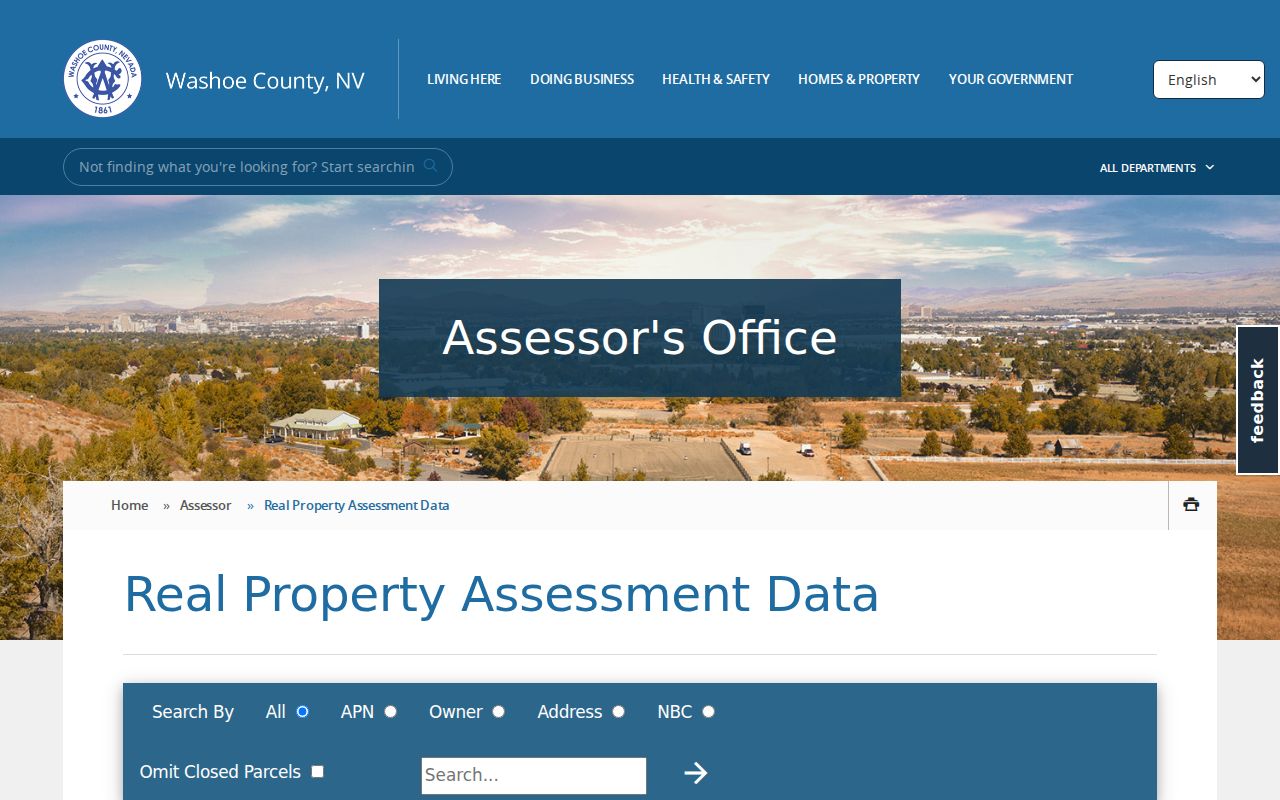
Its live search switches among all records, APN, owner, address, and neighborhood code, then returns sortable parcel, situs, and owner results. The full access chain also includes GIS, the treasurer’s tax query, the assessor counter, recorded deeds, permits, and library reverse directories for past occupants.
Nevada Court Records by Level
Nevada’s appellate portals search statewide cases by party or docket number. Trial files do not share one complete statewide party search. Municipal courts handle city matters, justice courts handle limited cases, and district courts hold general civil, criminal, family, probate, guardianship, and divorce files. Use the Nevada court locator, then check that court’s site or clerk. The Nevada Court of Appeals portal displays the public appellate search entrance.
A public docket can include the caption, case number, filing date, parties, counsel, lower-court information, events, and disposition. Obtain official copies from the clerk. Sealed filings and confidential identifiers remain restricted.
Clark County’s Eighth Judicial District inquiry covers civil, criminal, family, and probate categories.
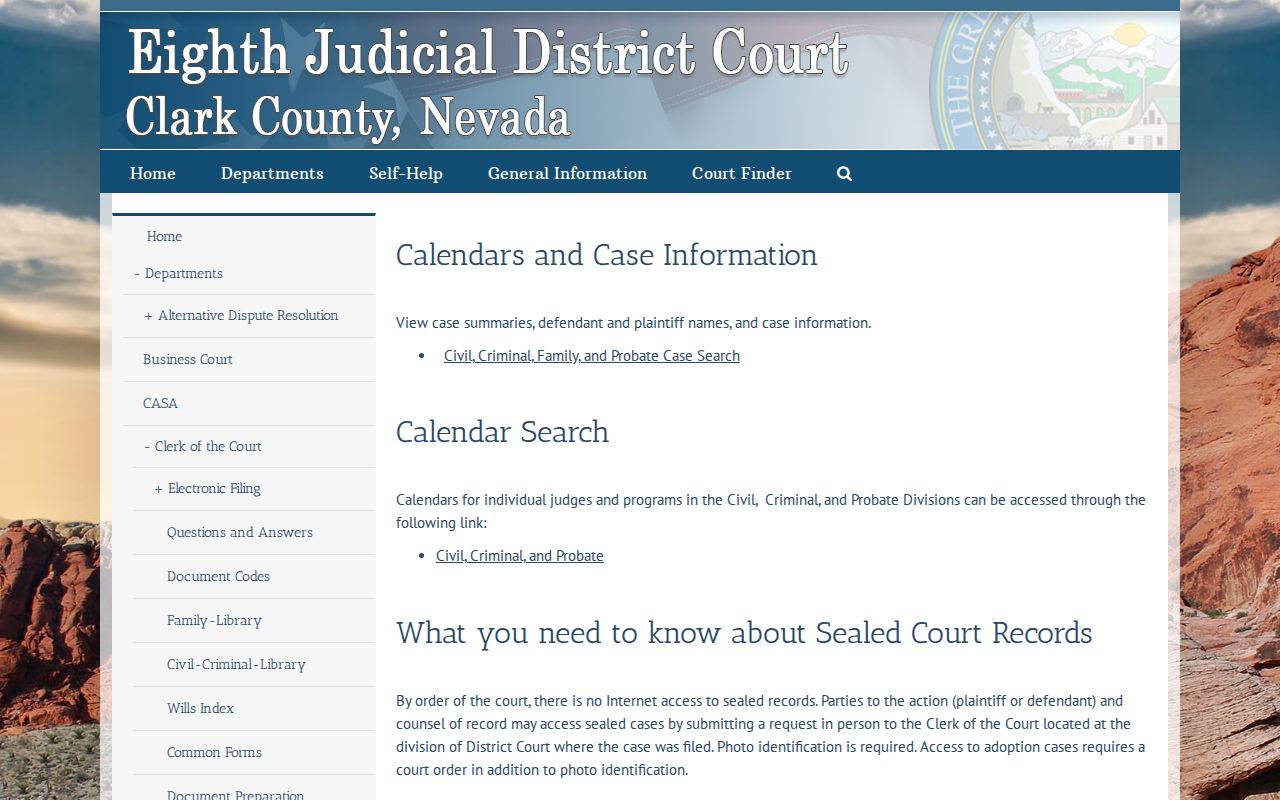
The screen illustrates why the court level matters. Clark results can include summaries, parties, hearings, and public minutes, while some family minutes and locked or sealed cases stay offline. Washoe also accepts a prepaid written records search at 50 cents per name per year. Clerk terminals, phone inquiry, mail, and archive retrieval remain valid fallbacks.
Nevada Vital Record Boundaries
The Nevada Office of Vital Records keeps statewide birth and death certificates from July 1, 1911. Under NRS 440.120, birth information becomes releasable after 125 years and death information after 50 years. Before those points, a qualified applicant must show photo identification plus the relationship or direct legal interest required by NRS 440.650 and NAC 440.070.
The Nevada vital-record forms page separates birth and death applications and current fee information.
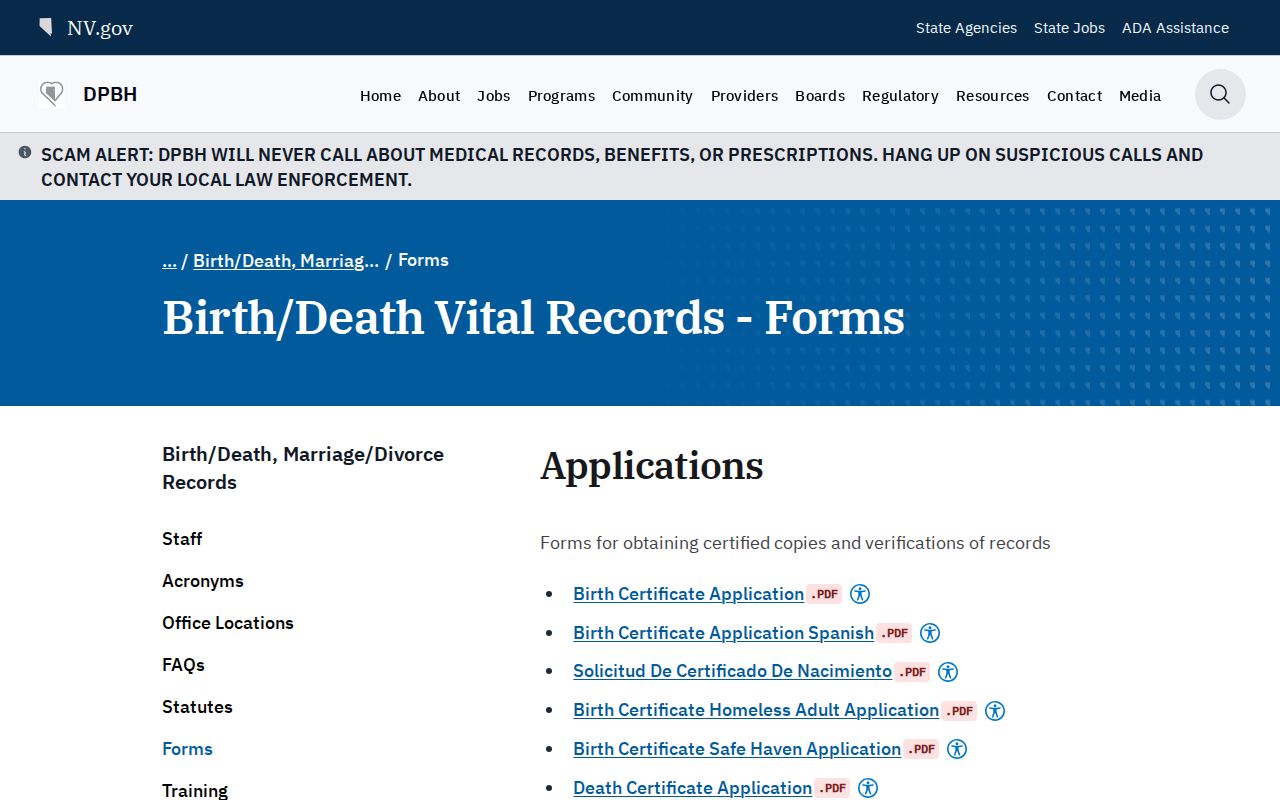
The state accepts mail applications with identification, proof, payment, and a signed form; online and phone orders use its authorized vendor, and in-person service is also available. Birth copies cost $25. Death copies cost $25 for events in Carson City, Clark, Douglas, Lyon, Mineral, and Washoe, and $22 for other counties. Never mail cash.
Marriage licenses come from county clerks, and divorce decrees come from district-court clerks. A $10 state verification can identify where and when a marriage or divorce occurred, but it is not the license or decree. For an event before July 1911, begin with county registers, archives, church or cemetery sources, and newspapers.
Nevada Custody Record Routes
State prison, county jail, registry, and police records use separate channels. The Nevada Department of Corrections search accepts either an offender ID or a first and last name, with a percent sign wildcard. Results may show an ID, aliases, demographic details, photo, institution, status, sentence, and release data. NDOC labels the output as raw data, so request verification from Offender Management when an official record is needed.
- Use the county sheriff roster for current local jail custody.
- Use NDOC for people in the state prison system.
- Use Nevada VINE for free custody-status notifications.
- Use the official registry for its published public-safety fields.
- Ask the creating police agency for a report by event number, date, and place.
Active investigations, victim details, juvenile information, and other protected fields may be withheld or redacted. A county detainee may never appear in the state prison system.
Lawful personal use. Nevada access never permits stalking, threats, repeated unwanted contact, impersonation, or harassment. Verify custody and registry data through the official keeper.
Nevada Public Records Offices
State offices provide vital, appellate, archive, prison, business, and agency-record channels. Local offices remain essential for recorder, assessor, tax, marriage, trial-court, jail, permit, and police material. Contact the legal keeper, not a general state switchboard. Three useful statewide contacts are below.
Nevada Office of Vital Records
4150 Technology Way, Suite 104
Carson City, NV 89706
(775) 684-4242
Nevada State Archives
Territorial, executive, legislative, judicial, and selected local holdings
Nevada Appellate Clerk
Public appellate file examination and status
(775) 684-1600
Archives staff can help with territorial, prison, census, land, and institutional series that have transferred there. Naturalization and ordinary local court files instead route to district courts, counties, federal keepers, or another repository with custody.
Nevada Record Costs and Copies
NRS 239.052 caps ordinary reproduction fees at actual cost. NRS 239.055 allows a reasonable added fee when a request requires extraordinary staff or technology use, but the agency must provide a written estimate. Inspection and focused electronic delivery are often the least costly choices. Certification is useful when the keeper’s authentication matters, not for every first review.
County charges vary. Washoe provides free watermarked recorder images, charges $1 per page for a plain copy, and adds $4 for certification. Clark copy orders need the instrument or book number and page count. Its online system adds a 2 percent plus $1.25 transaction fee. Mail and counter payment rules also differ, so read the keeper’s current instructions before sending funds.
Note: Narrow a request by date, file number, parcel, or document type before approving extraordinary search or copying costs.
Nevada Historical Records Access
Territorial records can predate Nevada state agencies. County names and boundaries also changed, and Carson City consolidated with Ormsby County in 1969. A modern county portal may therefore be the wrong endpoint for an older deed, court file, census entry, or vital event. Rural counties can rely more on limited online years, scanned books, counter staff, telephone research, and written copy requests.
Nevada Supreme Court case files from 1862 through 1999 were digitized through a law-library project. Access requires registration for a Supreme Court Law Library card. For recorder books, combine the county office’s terminal or microfilm with State Archives, repository catalogs, and FamilySearch access where available. Pre-1911 birth and death research may also depend on county registers, newspapers, cemetery logs, and church records.
Request Nevada Public Records
The Nevada Public Records Act, NRS Chapter 239, opens nonconfidential government books and records. Any person may request an identifiable existing record. An agency need not answer a question, perform new research, or create a custom compilation. The correct agency must act by the end of the fifth business day, though that deadline governs its first response rather than guaranteed completion.
The Governor’s public-record request instructions show the state submission model and request form.
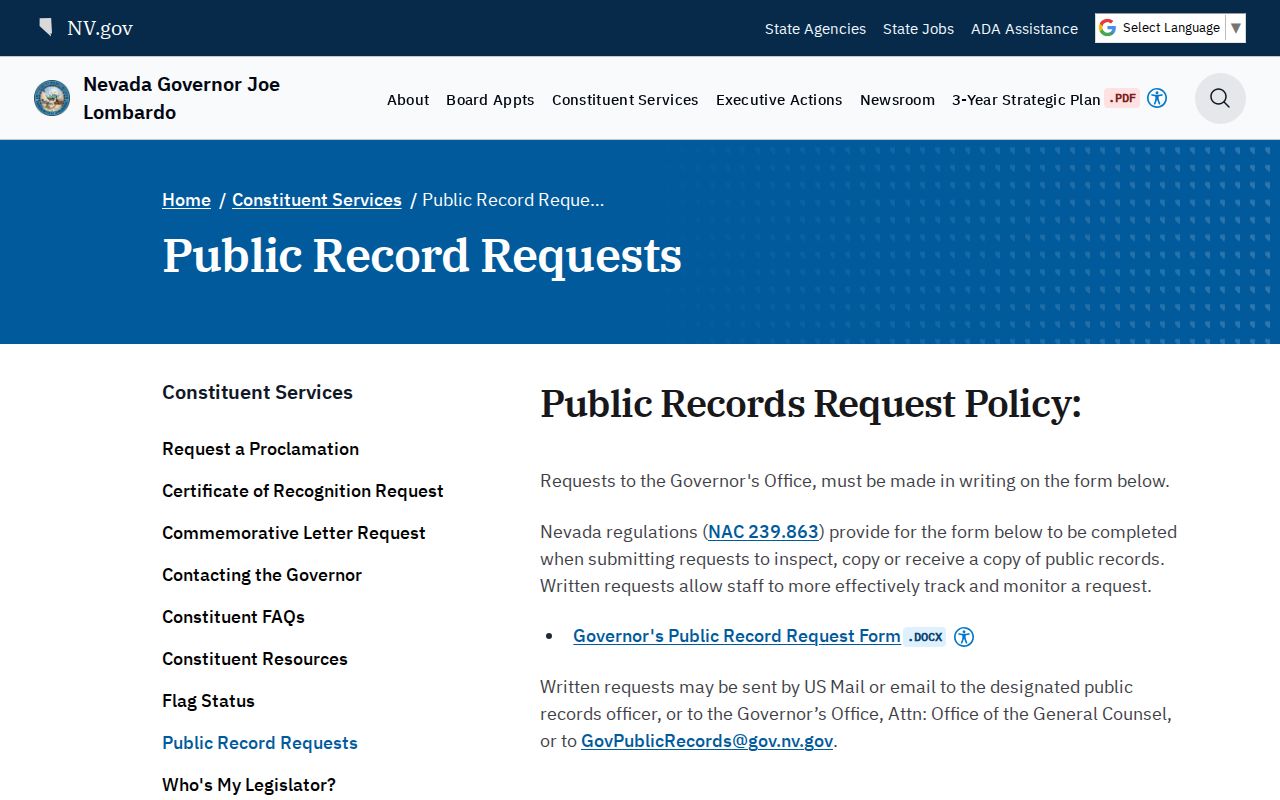
The form asks for contact details, a focused description, date range, preferred format, and fee acknowledgment. The Governor’s Office accepts written requests by email or mail. Every other Nevada agency names its own records officer.
- Identify the office with legal custody. Record the county, agency, court level, and file type.
- Search its portal or inspect at the counter. Save any case, parcel, instrument, or license number.
- Describe the existing record, subject, office, and date range. Choose inspection, electronic delivery, or paper.
- Submit through the keeper’s portal, email, mail, or counter channel. Ask for a written estimate before costly work.
- Review the response. The agency must produce, refer, give a reasonable date, or cite legal authority for denial.
Nevada Records Denials and Privacy
A written denial should identify the statute or other legal authority that makes the material confidential. Ask whether the keeper can release a segregable portion with protected fields redacted. NRS 239.011 allows an application to district court, and NRS 239.0113 places the confidentiality burden on the government. Records at least 30 years old receive a rebuttable access framework under NRS 239.0115, but listed exceptions still apply.
Nevada’s Confidential Address Program shields actual addresses for qualifying participants under NRS Chapter 217. DMV personal information is limited by state law and the federal Driver’s Privacy Protection Act. Recent certificates, sealed court files, authentication data, and library-user records have their own barriers. Do not try to defeat those protections through another portal.
A current court-data issue sharpens the distinction. Nevada’s 2026 Courts Data Warehouse privacy policy preserves public access to aggregate statistics while sending requests for specific case detail to the court that holds the file. Statistical access is not a substitute for a clerk-certified case record.
Note: When an index conflicts with a copy, rely on the custodian’s current file and ask how corrections or annotations are handled.